Location
Church of Archangel Michael – the Rotunda, Episkopi
Episkopi, Chania
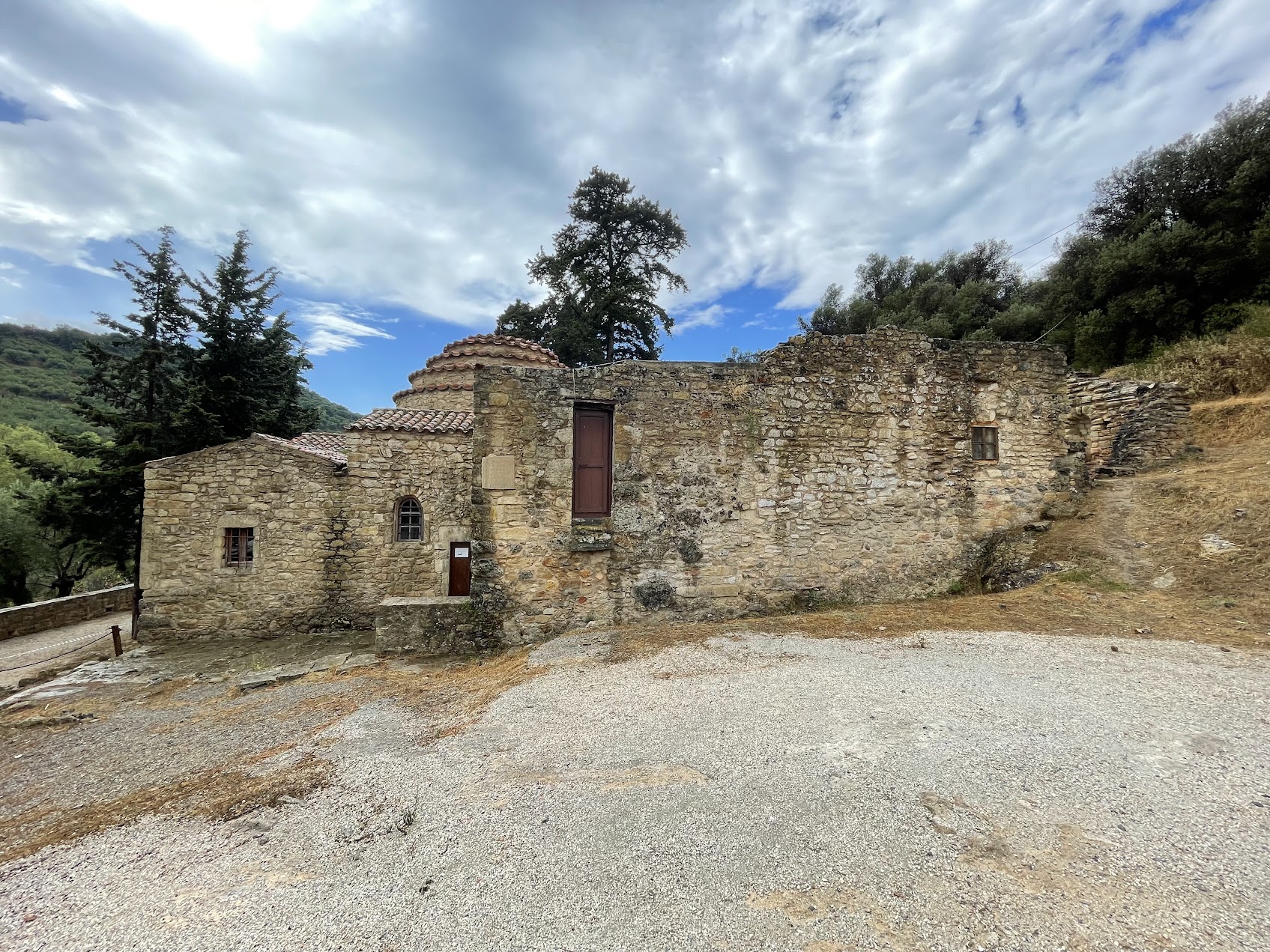
Church of Archangel Michael – the Rotunda, Episkopi – Episkopi, Chania
The Church of Archangel Michael in Episkopi, known as the Rotunda, is one of the oldest and most important monuments of early Christian architecture on Crete. Its origins date to the sixth century AD, and the structure combines the form of a rotunda with elements of a basilica. The sanctuary is renowned for its unique floor mosaics and Byzantine frescoes, among the oldest preserved on the island. The Rotunda at Episkopi stands as a remarkable testament to the transition from early Christian to Byzantine sacred architecture on Crete.
Description
The Church of Archangel Michael in Episkopi, commonly known as the Rotunda, is one of the most extraordinary examples of early Byzantine sacred architecture on Crete. It was erected in the sixth century AD, during the reign of Emperor Justinian I—the same era that produced the Hagia Sophia in Constantinople.
Its ground plan is highly unusual for Crete: it combines a central rotunda (a circular nave covered by a dome) with three apses, forming a hybrid between an early Christian *martyrion* (a shrine-mausoleum) and a classical basilica. This layout strongly suggests that the structure may originally have served as an episcopal church (*episkopē*), a reading supported by the very name of the settlement.
Inside, the church is adorned with floor mosaics made from fine marble and stone tesserae, depicting geometric designs, vine scrolls, and symbolic representations of animals—such as the peacock, deer, and fish, all of which are early Christian symbols of eternal life and Christ. In a later phase, probably in the twelfth–thirteenth century, the walls were covered with frescoes of high artistic quality, featuring episodes from the life of Christ, angels, and Archangel Michael—the patron of the sanctuary.
The style of the frescoes reveals influences of the Constantinopolitan school, yet with a distinctly Cretan character: monumental figures, vivid colours, and strong modelling of light. Among them, the depiction of Archangel Michael dressed as a Roman warrior—with shield and spear—stands out as a symbol of the triumph of good over evil.
From the outside, the structure retains its original, austere appearance: the circular outline of the central space, stone walls interspersed with brick, and small windows in the apses. Around the church, archaeologists have uncovered traces of the former episcopal complex—a cemetery, a baptistery, and foundations of auxiliary buildings.
During the Byzantine period, the Rotunda served as the seat of one of Crete’s principal bishoprics, overseeing the northern part of the island. After the Arab invasion in the ninth century the church was partially destroyed, but it was rebuilt during the second Byzantine period (after 961), faithfully preserving its original plan.
Today, the Rotunda at Episkopi is one of Crete’s most important sacred monuments, visited by art historians and pilgrims alike. Its stones carry the story of endurance—from the earliest centuries of Christianity to the present day.
In the silence of the interior, when sunlight falls through the narrow windows and illuminates fragments of the mosaic floor, one understands why this church has endured through the centuries: it unites the earthly and the heavenly, human craftsmanship and divine geometry. The Rotunda at Episkopi is a miniature Cretan Hagia Sophia—full of harmony, light, and the memory of Christianity’s earliest centuries.
Location
Episkopi, Chania
Coordinates: 35.49084, 23.76323