Location
Agiofarago Gorge
Mires Municipal Unit, Heraklion
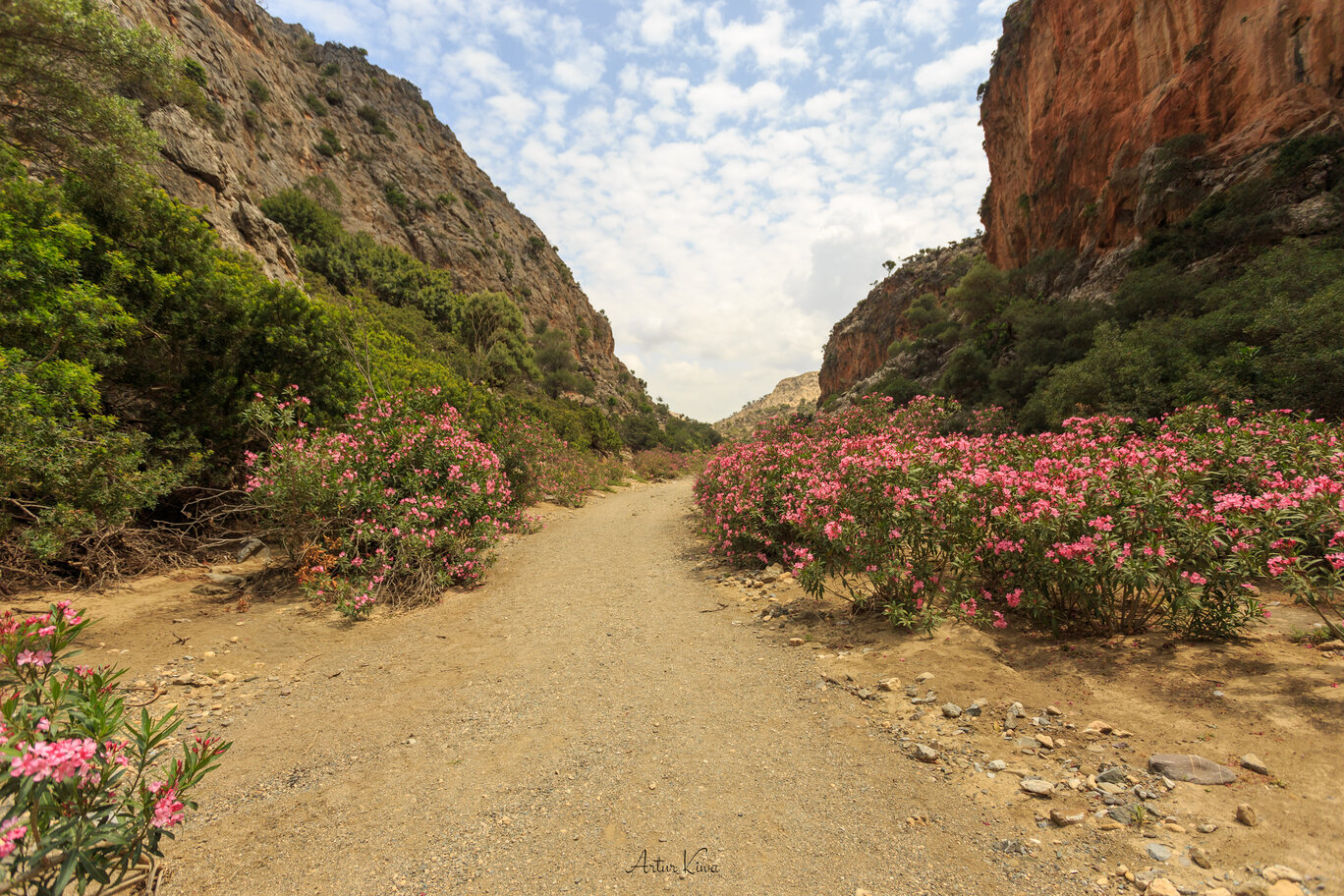
Agiofarago Gorge – Mires Municipal Unit, Heraklion
Agiofarago (Αγιοφάραγγο) is a short, easy gorge in the Asterousia range, south of the Monastery of Panagia Odigitria, in the Heraklion region. A comfortable path of about 1.5 kilometers runs along the wide bed of a stream, enclosed between high limestone walls and dense oleander shrubs. At the end awaits a small, secluded beach with crystal-clear water — one of those places where southern Crete reveals its harsher, hermitic character: rock, wind, silence, and traces of former hermits hidden in caves and in the tiny church of Saint Anthony.
Description
Agiofarago Gorge begins a few kilometers south of the Monastery of Panagia Odigitria, which is reached by an asphalt road via the village of Sivas in central Crete. Beyond the monastery, the route continues along an unpaved road: from the monastery grounds you drive onto a dirt track heading south, toward the sea and the mouth of the gorge. This is the official access route described in guidebooks to the trailhead.
The dirt road from Odigitria is narrow, rocky, and in places heavily worn. Near the end it descends toward the streambed, where the road crosses the dry channel several times — a channel that carries water to the sea after winter rains. In summer the stream is usually minimal, and passage by a standard passenger car is generally possible, provided the driver has some experience with gravel roads and is not deterred by inclines or ruts. Regardless of the season, it is advisable to drive slowly, watch for loose stones, and be mindful of steep edges. Local sources and traveler accounts consistently note that the access road “is not the easiest,” although an ordinary car usually manages it.
The final stretch of the dirt road ends at a small, unpaved parking area at the start of the trail. Sources describe it as a modest clearing in the valley with a few trees — accompanied by a very Cretan piece of advice: it is better not to park directly under branches, as goats like to climb onto car roofs to reach fresh leaves.
From the parking area to the sea runs the most popular version of the route: about 1.5 km of gentle descent along the bed of Agiofarago Gorge. Various sources — Greek, English, and Polish — consistently give a walking time of around 25–35 minutes at a relaxed pace. The path follows the wide streambed, which is relatively even, with gravel and stones in places, and only minor elevation differences (on the order of several dozen meters). The gorge is considered easy and suitable even for less experienced walkers, provided one takes into account the heat, the lack of shade at midday, and the complete absence of infrastructure along the way.
The landscape is typical of the Asterousia Mountains: high, vertical walls of pale limestone, eroded into dozens of caves and niches; oleander thickets along the streambed; and scattered junipers and shrubby oaks on the slopes. Many descriptions repeat the motif of a “walk along a streambed” — in practice, one walks through a broad, dry channel enclosed by steep rock faces that draw closer together as the sea approaches, creating an almost canyon-like effect.
Agiofarago is not just a walking route — it is also one of the historically important centers of hermitic life on Crete. The name means “Holy Gorge” or “Gorge of the Saints” and refers to the hermits associated with the Monastery of Panagia Odigitria, who lived in the local caves from the early Christian period onward. According to local tradition, there were once even several hundred hermits living here, and once a year they were said to gather in the cave of Goumenospilios to count how many had died since the previous meeting. Although the numbers and details belong to legend, they convey well the significance of this place in the history of Cretan monasticism.
A few minutes before reaching the beach, the gorge widens, and on the left side appears a small stone church of Saint Anthony (Agios Antonios). This became the center of the local hermitic community. Researchers believe the church underwent several phases of reconstruction — initially as a small chapel set into a natural rock recess, later expanded as the number of hermits grew, with the last major interventions dated to the 14th–15th centuries. Beside the church is a well with water, described both as a practical source and as a place locally associated with healing properties.
Just before the beach, the gorge narrows slightly, forming a natural gateway between the rocks. Agiofarago Beach itself is small and pebbly, enclosed by high cliffs, with crystal-clear water and a distinctive rock arch on the western side that can be swum through. Owing to its isolation, the place remains relatively quiet, especially outside the high season, although on fine days boats may arrive from Matala, Agia Galini, Kokkinos Pyrgos, or Kali Limenes.
Agiofarago is also one of the most important rock-climbing areas on Crete. The steep walls in the lower part of the gorge and near the beach offer dozens of bolted routes of varying difficulty; some sources emphasize that several lines rank among the hardest on the island. For hikers, this means that even without climbing themselves, they are likely to see climbers overhead — both in the central section of the gorge and right by the sea.
In addition to access from Odigitria and the walk through the gorge, there are other ways to reach Agiofarago. It can be approached by boat from several ports along the southern coast (including Matala, Agia Galini, Kokkinos Pyrgos, and Kali Limenes), which can be an appealing option in intense heat or for combining a short hike with a boat trip. It is also possible to hike in from Kali Limenes along a longer, scenic route, but this is an option for those in better physical condition — typically described as about 6–7 km one way with more than 200 meters of elevation gain.
As a practical note: the gorge itself is technically easy, but the location is remote. Visitors should bring sufficient water, head protection, and choose a sensible time of day — at midday the rocks can radiate heat like an oven, and shade is scarce. Sources consistently advise against entering the gorges of the Asterousia range when heavy rain is forecast. Although classic flash floods are rare in Agiofarago, the same caution applies as in any mountain canyon.
In summary, Agiofarago combines several worlds: a demanding approach but a short and accessible trail for most visitors; a stark, hermitic landscape with caves, the church of Saint Anthony, and the legend of the “Holy Gorge”; and a small, well-hidden beach where the day can end with a swim in the sea. Locals and guidebooks usually say simply “Agiofarago,” without adding the word “gorge” — but in practice it is this short canyon, rather than just the beach itself, that forms the core of the experience.
Location
Mires Municipal Unit, Heraklion
Coordinates: 34.93721, 24.78158