Location
Arkadi Monastery
Rethymno
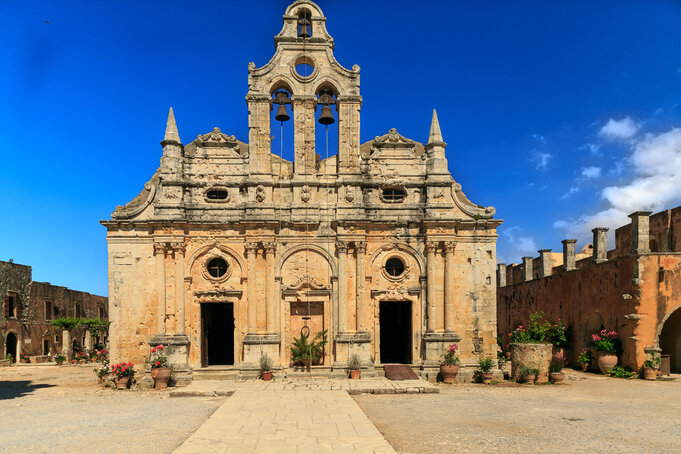
Arkadi Monastery – Rethymno
Arkadi Monastery is one of the most symbolic places on Crete and in all of Greece. Founded in the Byzantine period, the present monastic complex dates mainly to the sixteenth century, during Venetian rule. The monastery became famous for its heroic stand during the Cretan revolt against the Ottomans in 1866, when its defenders blew up the powder magazine rather than fall into enemy hands. This event made Arkadi a symbol of sacrifice and the Greek nation’s longing for freedom.
Description
Arkadi Monastery, located among the hills of the Amari plateau, is one of the most sacred places on Crete, both spiritually and nationally. According to tradition, its origins go back to the fifth century CE, when a small monastery founded by the monk Arkadios stood here. The present complex was rebuilt in the sixteenth century by the Venetians, during the flourishing of Renaissance art on the island.
The monastery’s main church (katholikon) is dedicated to the Transfiguration of Christ and Saint Constantine. Its façade, built of local sandstone, is a masterpiece of Cretan Renaissance architecture, combining Gothic and Baroque elements with columns, decorated portals, and reliefs inspired by Italian masters. The interior of the monastery preserves a medieval character, with massive walls, narrow windows, and quiet cloisters surrounding the courtyard.
Yet Arkadi is remembered above all as the site of a tragic act of heroism. In November 1866, during the great Cretan uprising against Ottoman rule, the monastery became a refuge for around 900 people: monks, rebels, and civilians, including women and children. After two days of siege, when the Turks broke through the gates, the defenders understood they had no chance. Abbot Gabriel Marinakis and the rebel Kostas Giamboudakis made a desperate decision: to blow up the powder magazine rather than surrender the monastery and its people to the enemy.
The explosion that shook the Amari valley killed most of the defenders and attackers, and the monastery was almost completely destroyed. News of the event spread across Europe, evoking widespread sympathy and admiration. Arkadi became a symbol of freedom and sacrifice, often compared to Missolonghi in modern Greek history.
Today the rebuilt monastery is a place of pilgrimage and national memory. In the former powder magazine, the marks of the explosion are still visible, and a small museum preserves weapons, icons, and everyday objects from the time of the uprising. In the ossuary housed in the tower by the entrance lie the remains of those who fell, resting in silence broken only by the wind and the song of cicadas.
Walking through Arkadi’s courtyard feels like a prayer intertwined with history. It is more than a monastery; it is a Greek Golgotha, a place where the sacred and the heroic have merged into one. Every year on November 8, the anniversary of the siege, thousands of Cretans come here with flags and candles to honor those who chose death over captivity in Arkadi.
Location
Rethymno
Coordinates: 35.31006, 24.62899