Location
Church of Christ the Saviour, Meskla
Meskla, Chania
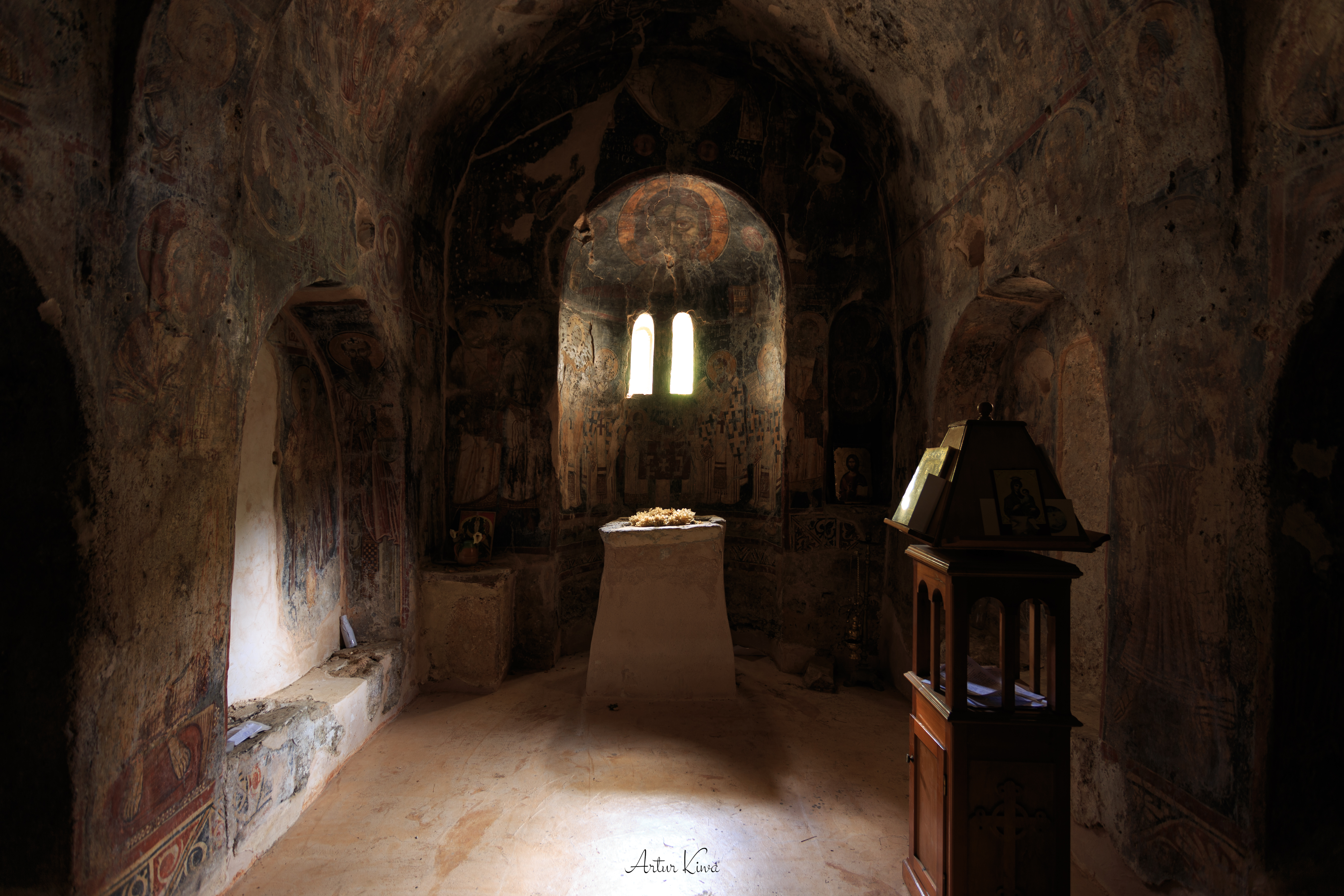
Church of Christ the Saviour, Meskla – Meskla, Chania
The Church of Christ the Saviour (Ναός του Σωτήρα Χριστού) in the village of Meskla, situated in a lush valley at the foot of the White Mountains in western Crete, is a small yet remarkable late-Byzantine church. Built most likely in the fourteenth century, it stands out for its valuable ensemble of frescoes attributed to the Cretan painter Michael Veneris. The painted decoration includes scenes from the life of Christ, depictions of saints, and the traditional Pantokrator in the dome. Despite the passage of time, the frescoes retain vivid colours and precise details, offering an important source of insight into the local iconographic tradition. The church is built on a rectangular plan, with a single nave and a characteristic apse. Hidden among olive and cypress trees, it remains a quiet place of contemplation and a significant landmark in Crete’s sacred heritage, blending spirituality, history, and art within an intimate rural setting.
Description
The Church of Christ the Saviour in Meskla (Ναός του Χριστού του Σωτήρα) is one of the most valuable examples of rural sacred architecture from the late Middle Ages in western Crete. Situated in the picturesque valley at the foot of the Lefka Ori (White Mountains), in the municipality of Therisso near Chania, it stands as a testament to the spiritual and artistic flourishing of the region during the Venetian period.
It was probably built in the first half of the fourteenth century as a small, single-nave church with a semicircular apse and a barrel vault. The interior is almost entirely covered with frescoes that have survived in surprisingly good condition despite the passing of centuries and the effects of the Cretan climate. The painted decoration is of great importance for the history of Cretan art and is attributed to the well-known painter Michael Veneris (Μιχαήλ Βενέρης), active in the fourteenth century in western Crete. Veneris belonged to the so-called “provincial Cretan school,” which blended the Byzantine artistic tradition with local stylistic elements.
The iconographic programme follows the standard layout of Byzantine churches: in the dome appears the figure of Christ Pantokrator, while the side walls display scenes from the life of Christ, including the Annunciation, Nativity, Baptism, Crucifixion, and Resurrection. The lower registers of the apse and the nave feature frontal depictions of saints—among them the Archangels, Saint Nicholas, Saint George, and Saint John the Baptist—typical of Byzantine visual language.
Noteworthy are the local decorative features, such as the details of garments that reflect the realities of Venetian-era Crete, and the expressive faces in which the painter conveys emotion rather than merely repeating liturgical formulae. The colour palette revolves around ochres, reds, and blues, with well-preserved contour lines and ornamental details.
Although modest from the outside and somewhat difficult to reach, the church is a key reference point for scholars of Cretan art. It also stands as evidence of how deeply faith was rooted in the daily life of the people of Venetian Crete. Today the church is usually locked, but access can be arranged through local caretakers. It is a place worth visiting not only for its artistic significance but also for the sense of silence and contemplation offered by its mountain setting.
Location
Meskla, Chania
Coordinates: 35.40551, 23.95798