Location
Early Christian Basilica of Saint Titus at Gortyn
Gortyna, Heraklion
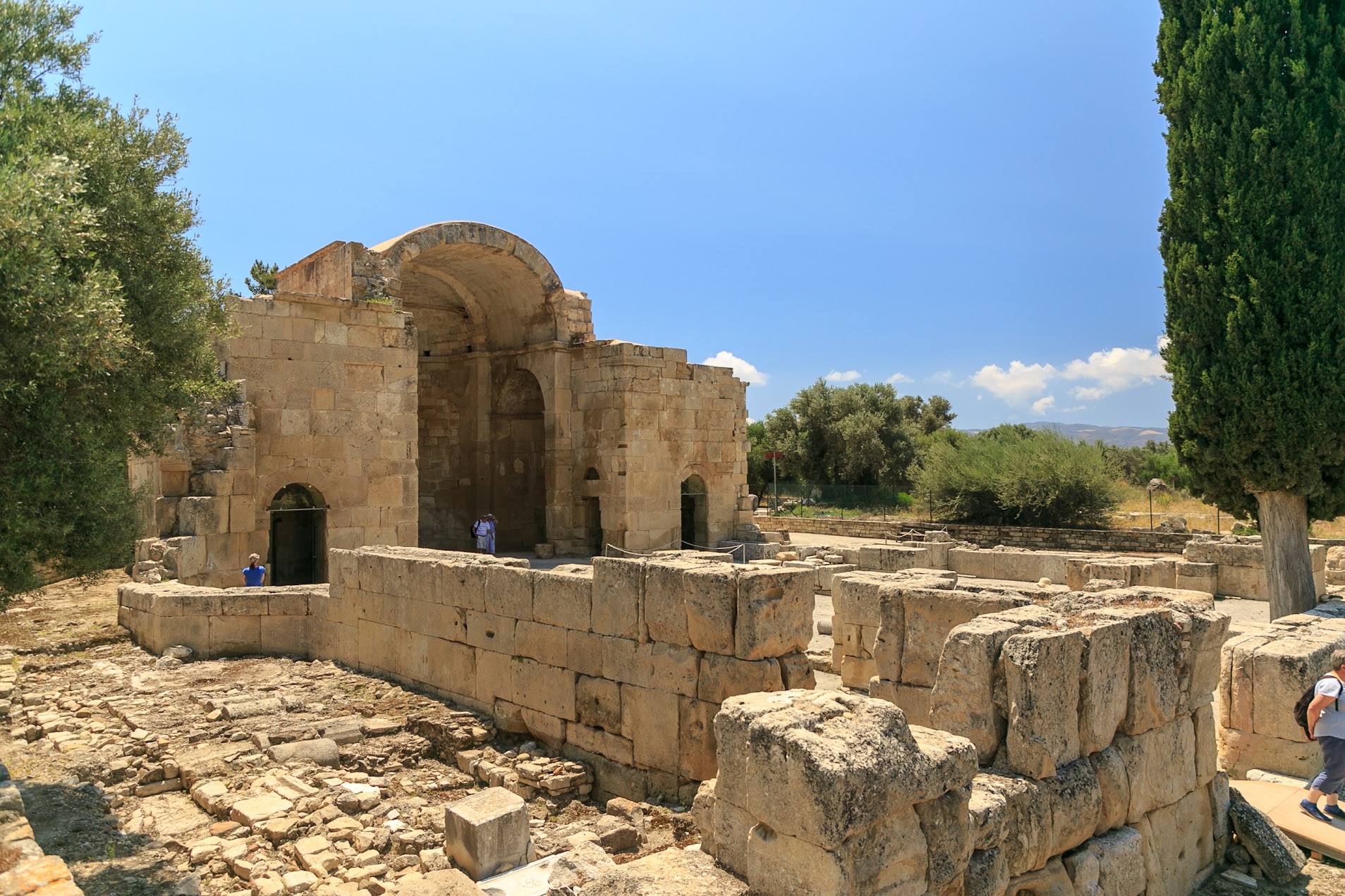
Early Christian Basilica of Saint Titus at Gortyn – Gortyna, Heraklion
The Church of Saint Titus in Gortyn is one of the most symbolic sites of early Christianity on Crete—a sanctuary associated with the disciple of Saint Paul, the island’s first bishop and its patron. Located within the ancient city of Gortyn, once the metropolis of the Roman province of *Creta et Cyrene*, the church exemplifies a rare layering of eras: Greek, Roman, early Byzantine, and later medieval periods. According to tradition, Saint Titus was buried here, and traces of this belief have endured in the archaeological structures, in the ruins of the basilica, and in the later testimonies to a cult that persisted on Crete throughout the Middle Ages. Gortyn itself is one of the most important cities of ancient Crete, and the Church of Saint Titus forms its spiritual and historical centre—a place where religion, architecture, and the politics of the early Christian era are woven into a single narrative.
Description
The sanctuary was most likely built in the sixth century as a monumental basilica, befitting the status of Gortyn, which at that time served as the provincial capital and the seat of the archbishop of all Crete. It was conceived as a three-aisled basilica with a transept, a grand presbytery, and a large apse—architectural features characteristic of the early Byzantine period. The interior was probably adorned with mosaics and decorative elements, today preserved only in fragments or known from descriptions by early researchers.
According to Christian tradition, beneath the floor of the basilica lay the tomb of Saint Titus, the disciple of the Apostle Paul and the addressee of the “Epistle to Titus.” Titus is believed to have been the first bishop of Crete, entrusted with organising the Church on the island during the apostolic age. His cult remained vivid throughout the Middle Ages—both in Gortyn and later in Heraklion, where his relics were transferred due to repeated threats and destruction.
The decline of Gortyn, accelerated by earthquakes and later devastation during the Arab period, led to the gradual abandonment of the city, and the church itself slowly fell into ruin. Yet fragments of walls, the apse, and foundation lines remain clearly visible, preserving the outline of a structure that, in its prime, was one of the largest churches in early Christian Crete.
Archaeologically, the Church of Saint Titus forms a key element of the Gortyn complex. In its immediate surroundings stand the Roman odeon, the famous Gortyn Law Code inscribed on stone walls, and the remains of houses, baths, aqueducts, and other urban structures. This concentration of monuments from different eras allows the basilica of Saint Titus to function not only as a place of worship but as part of a broader narrative of urban continuity in this region.
For centuries, the site remained a destination for pilgrims—both from Crete and from the wider Hellenic world. Today, the ruins of the basilica are among the most significant locations visited in Gortyn: they testify to the Christianisation of the island, the early organisation of ecclesiastical administration, and the enduring cult of one of the key apostolic figures associated with Crete.
The Church of Saint Titus remains a foundational site for the history of Christianity on the island—a space that documents the passage from the ancient world to the early Christian era and that still preserves the singular atmosphere of what was once the religious and political heart of southern Crete.
Location
Gortyna, Heraklion
Coordinates: 35.06210, 24.94707