Location
Church of the Holy Fathers, Polyrrhenia
Polyrrhenia, Chania
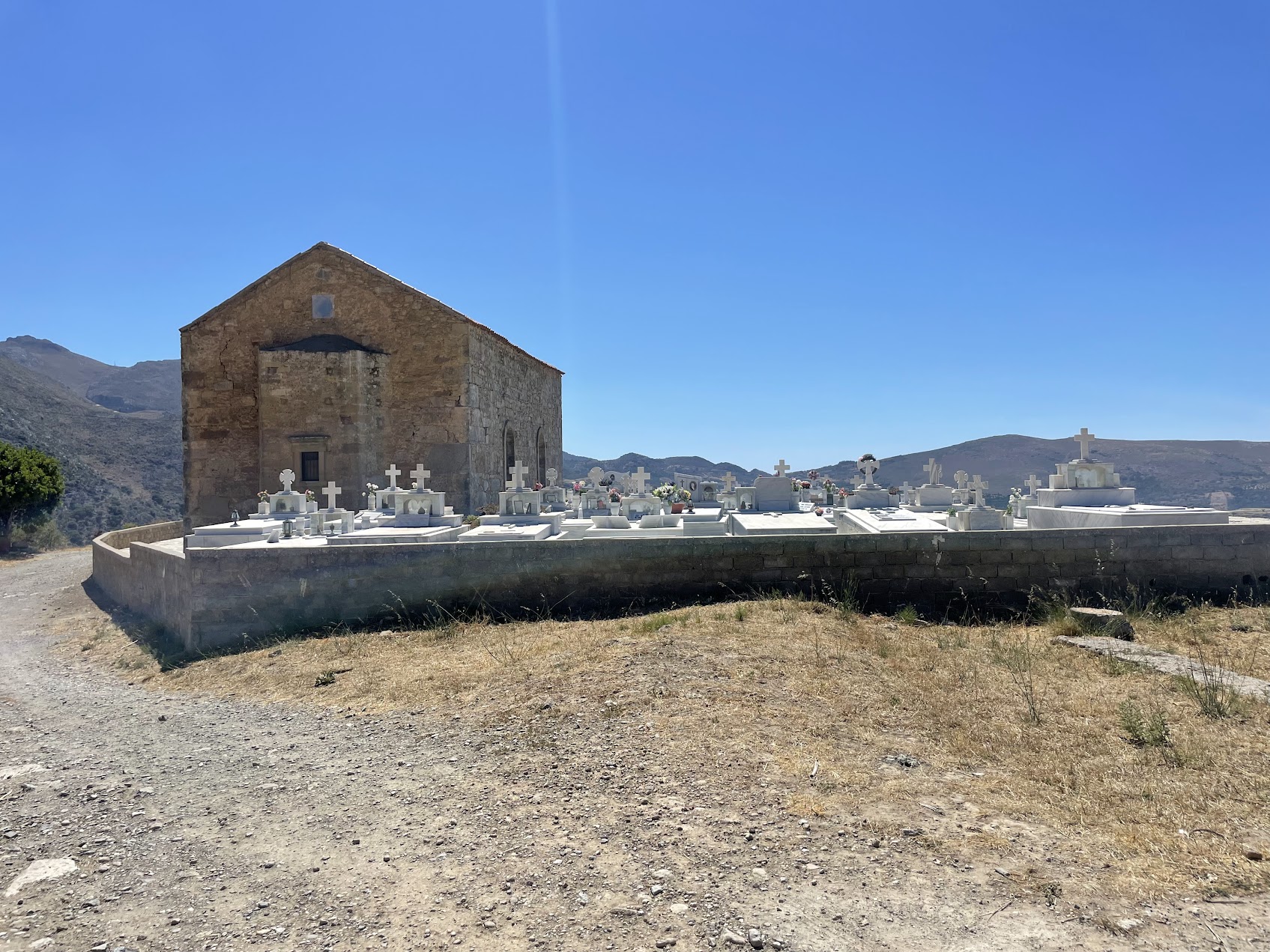
Church of the Holy Fathers, Polyrrhenia – Polyrrhenia, Chania
The Church of the Holy Fathers (Άγιοι Πατέρες) in Polyrrhenia is a small stone sanctuary built in the thirteenth–fourteenth century on the ruins of the ancient acropolis. It is one of the most valuable examples of Byzantine sacred architecture in western Crete. Situated atop a hill overlooking Kissamos Bay and the Rodopou Peninsula, the church preserves fragments of late Byzantine frescoes as well as elements of ancient columns incorporated into its walls.
Description
The Church of the Holy Fathers in Polyrrhenia stands on a site that for millennia served as the spiritual heart of this part of Crete. Its very foundations preserve the remains of the ancient acropolis—blocks of masonry and fragments of columns—silent evidence that the Christian sanctuary was built atop an earlier pagan one, in keeping with the symbolic practice of Christianising pre-existing cult locations.
Dating from the thirteenth–fourteenth century, the church represents the single-nave domed type (troullotos) characteristic of Byzantine Crete. Its interior was once adorned with frescoes depicting scenes from the life of Christ, prophets, and the Fathers of the Church. Some fragments—especially in the apse and dome—still survive. Among them are remnants of portrayals of the Pantokrator and angels, rendered in the late Byzantine style with strong facial modelling and a dark, expressive palette.
The church is dedicated to the Holy Fathers of the Ecumenical Council, defenders of orthodox faith according to tradition. For the people of Polyrrhenia, however, it served not only as a place of prayer but as a pilgrimage site offering a sweeping view of Crete on three sides—sea, mountains, and valleys—symbolically linking heaven and earth.
Embedded in the stone walls are pieces of ancient marble and blocks taken from the earlier Greek temple, likely dedicated to Zeus or Athena Polias, once venerated in ancient Polyrrhenia. The reuse of such material was not merely practical; it carried theological meaning, expressing the triumph of Christianity over former cults.
Around the church lie the remains of old fortifications and rock-cut grottoes which, according to local tradition, sheltered hermits and monks in the early Christian centuries. Even today, the place retains a singular atmosphere—of silence, light, and open space.
On the feast day dedicated to the Holy Fathers (the first Sunday after Pentecost), the hilltop fills with the people of Kissamos, who bring food and wine to share after the liturgy in the shade of olive trees.
The Church of the Holy Fathers in Polyrrhenia is one of those places where the history of Crete unfolds in layers—from an ancient polis to Byzantine devotion, from ruin to sanctity. The stone walls, still standing in the quiet of the hills, remind us that the spirit of this place has not faded; it has simply taken on a new form, just like Crete itself, which has never ceased to connect earth and heaven.
Location
Polyrrhenia, Chania
Coordinates: 35.45657, 23.65290