Location
Church of Panagia Myrtidiotissa, Plemeniana
Plemeniana, Chania
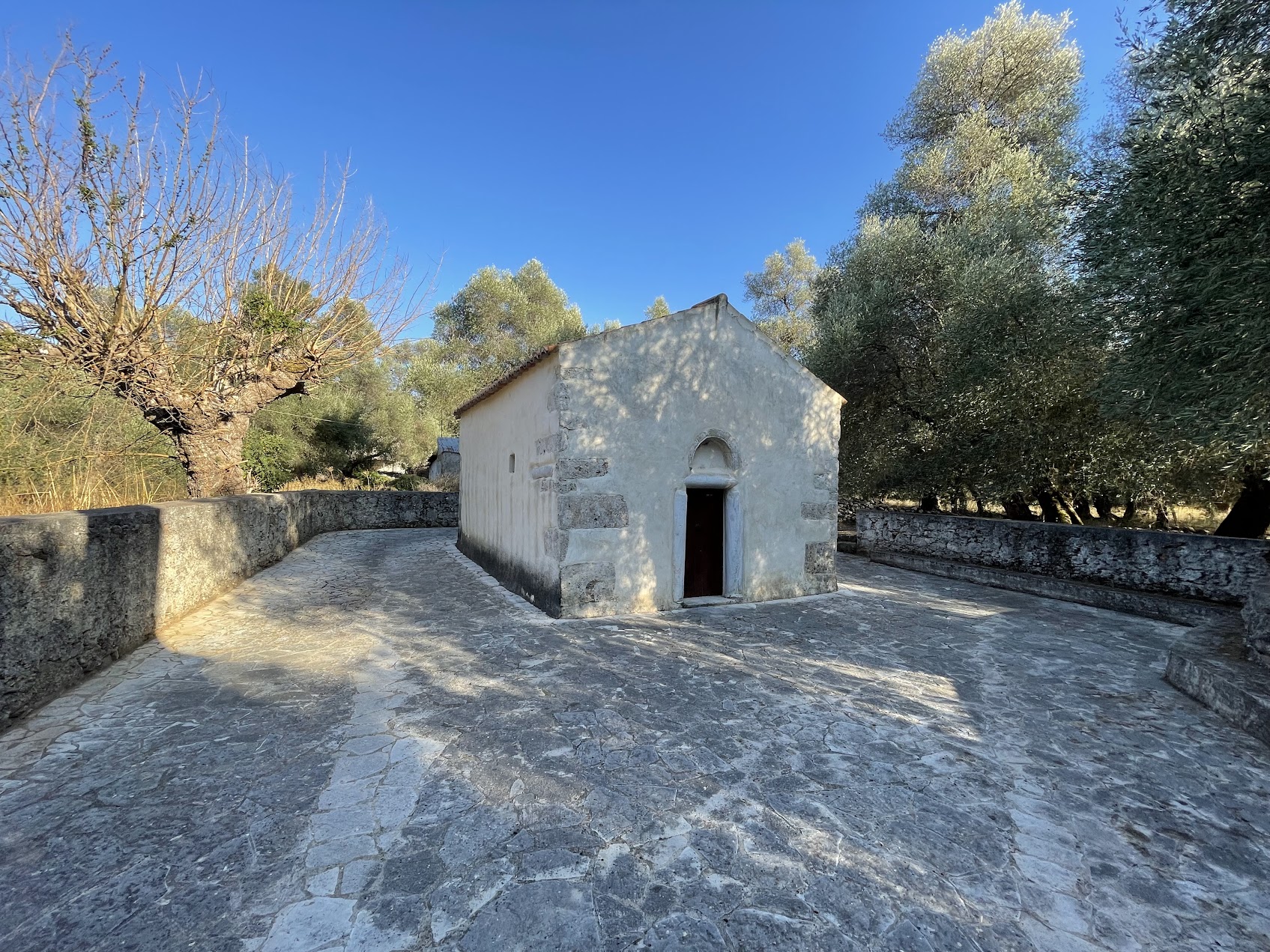
Church of Panagia Myrtidiotissa, Plemeniana – Plemeniana, Chania
The Church of Panagia Myrtidiotissa in Plemeniana is a small, single-nave Venetian-period sanctuary located in the village of Plemeniana in the Kandanos region of southwestern Crete. A short path leads to the church from the small bridge beside the main road to Paleochora. The building features a barrel-vaulted nave, and its central dome is reinforced with a special supporting arch (*sfendonion*). On the exterior, one can see marble architectural pieces embedded into the walls, originating from an early Christian structure from ancient Kandanos. The interior preserves frescoes, though in poor condition. They depict scenes from the Eucharistic cycle, the *Theotokion* (Mother of God cycle), the Christological cycle, and hagiographic themes. One fresco shows the donors surrounded by myrtle branches, directly referencing the epithet *Myrtidiotissa*. An inscription inside bears the date 1450. The Church of Panagia Myrtidiotissa in Plemeniana is an example of local sacred architecture from the Venetian period and stands as a testament to the rich religious history of the Selino region.
Description
The Church of Panagia Myrtidiotissa in the picturesque valley of Plemenianá, surrounded by olive trees and fields, may appear modest, yet it holds profound significance for the history of Byzantine art on Crete. Its dedication—“Our Lady of the Myrtles”—evokes the symbolism of the myrtle plant, long associated with purity, peace, and the protective care of the Mother of God, whose cult flourished on the island particularly in the fourteenth century.
The church was most likely built at the turn of the thirteenth and fourteenth centuries, a time when western Crete was under Venetian rule but Byzantine artistic tradition remained vibrant and deeply rooted. It follows a single-nave plan with a semicircular apse on the east, a tiled roof, and a simple stone-framed entrance. Despite its small size, the structure impresses with proportions and elegance characteristic of Cretan rural churches from that era.
The greatest treasure of the church is its fresco decoration, which—despite the passage of centuries—retains remarkable expressive power. On the north wall, one can distinguish the image of the Mother of God with the Child in the Hodegetria type (Οδηγήτρια), pointing towards Christ, as well as fragments of the Annunciation, Nativity, and Crucifixion. The stylistic features indicate the hand of an artist from the circle of Ioannis Pagomenos, active in the Selino region in the early fourteenth century. Strong contours, subtle modelling of the faces, and the emotional intensity of the figures are typical of that workshop.
In the apse, remnants of the Communion of the Apostles and scenes of the heavenly liturgy survive—motifs characteristic of the Eucharistic iconography of late Byzantium. The frescoes use a warm palette of reds, ochres, and blues, which lends a soft, almost golden light to the interior.
For centuries, the church served as a site of local devotion and pilgrimage. On the feast day of Panagia Myrtidiotissa (24 September), the inhabitants of Plemenianá and neighbouring villages gathered here for liturgy and communal celebration, bringing myrtle branches, olive oil, and wine. To this day, it remains customary to decorate the church with sprigs of myrtle—an echo of an ancient Byzantine rite.
Although often quiet now, the sanctuary’s silence is far from empty. In the glow of the midday sun, the frescoes seem to stir, and the stones from which the church was built still breathe the spirit of Byzantium. Panagia Myrtidiotissa in Plemenianá is one of those places where art, faith, and the Cretan landscape merge into a single narrative—one of endurance, simplicity, and timeless beauty.
Location
Plemeniana, Chania
Coordinates: 35.32639, 23.72807