Location
Asomaton Monastery
Monastiraki, Rethymno
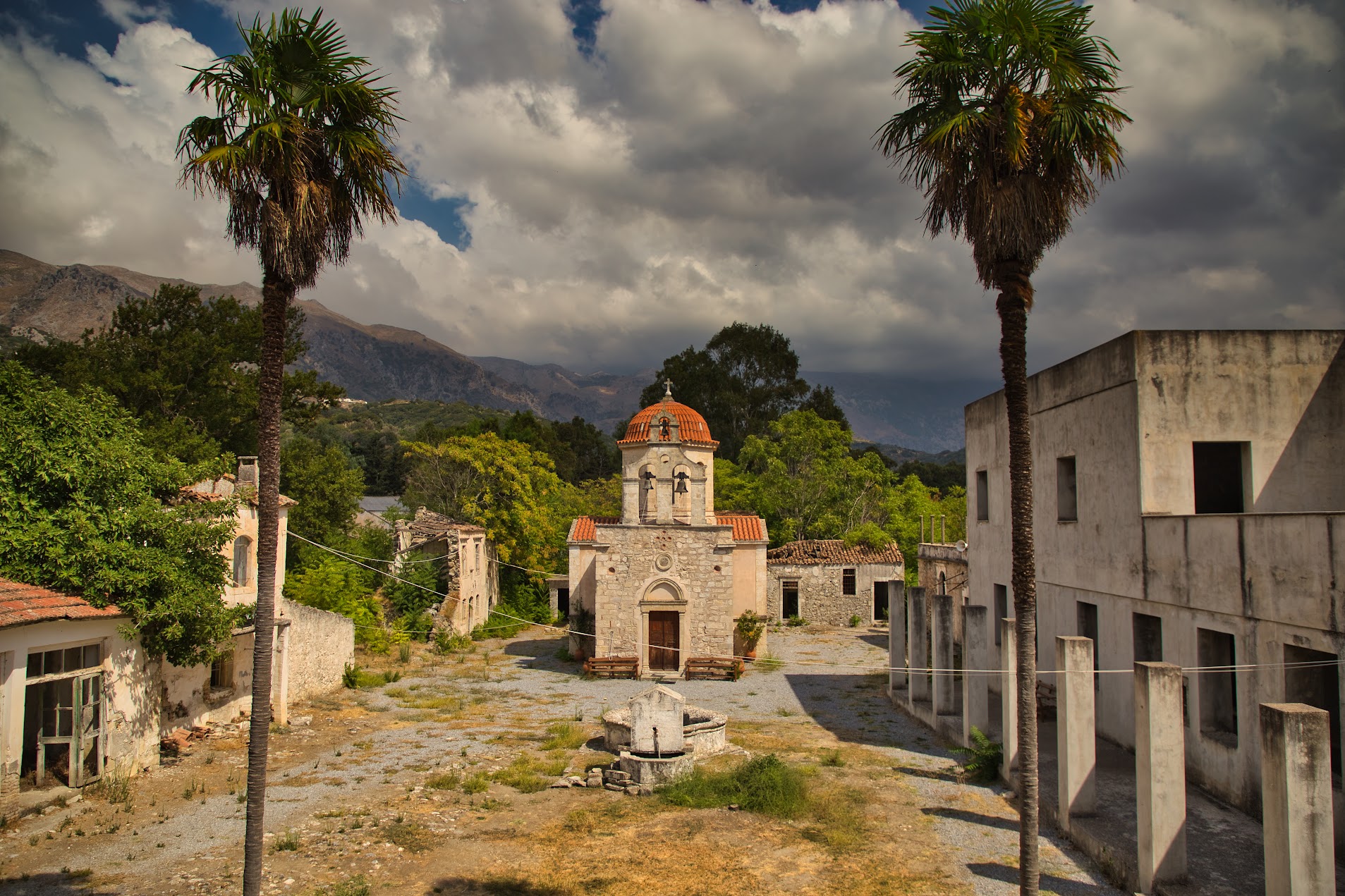
Asomaton Monastery – Monastiraki, Rethymno
The Asomaton Monastery, dedicated to the Archangels (Asomatoi, meaning “the Bodiless Ones”), is a former monastic complex of medieval origin located in the heart of the Amari Valley, one of the greenest and historically most significant regions of Crete. Although now in ruins, it was for centuries an important religious and educational center, and during the Ottoman occupation a hub of revolutionary activity. The surviving buildings, the ruined church, and fragments of the defensive walls bear witness to its former importance and the role it played in the life of the region.
Description
The Asomaton Monastery (literally “Monastery of the Bodiless Ones,” referring to the Archangels Michael and Gabriel) lies in the very heart of the Amari Valley, surrounded by olive trees, fields, and rolling hills that for centuries formed the spiritual backbone of central Crete. According to tradition, the monastery already existed in the late Byzantine period (thirteenth–fourteenth century), though the buildings that survive today date mainly from the sixteenth and seventeenth centuries, during Venetian rule.
During the Ottoman period, Asomaton was among the most active monasteries in the region. Its monks took part in the resistance, supported rebels, and sheltered the wounded and those involved in clandestine activities. The monastery also hosted a religious and literary school where Greek language, history, and theology were taught, a form of cultural resistance at a time when the Ottoman authorities promoted Turkification.
In the nineteenth century, during the 1866 uprising, the monastery again played a significant role. Weapons and supplies for rebels fighting in the Psiloritis mountains were stored here. After the revolt was crushed, the Ottomans partially destroyed the monastery, and after their withdrawal it never regained its former stature.
After the Second World War, the monastery gradually fell into abandonment. The monks left in the mid-twentieth century, and the buildings, deprived of care, deteriorated into ruin. Today, the remains include parts of the monastic structures, fragments of cells, a well, the partially collapsed katholikon, and traces of the wall that once enclosed the courtyard.
In recent decades, local authorities and archaeologists have made efforts to stabilize and protect the ruins, and the inhabitants of the Amari Valley regard the site with respect and nostalgia. A small number of services are still held here on the Feast of the Archangels, 8 November, when a few candles and sprigs of basil appear in the courtyard, symbols of life and remembrance.
Today, Asomaton is a place of silence. Overgrown with wild vegetation, the monastery seems to dissolve into the landscape, as if becoming “bodiless” itself, true to its name. The stones that remain no longer need words; they tell a quiet story of fidelity, oblivion, and passing — a story typical of the Cretan monasteries that once served as both fortresses of faith and bastions of freedom.
Location
Monastiraki, Rethymno
Coordinates: 35.24238, 24.66305